The fastest way to unify data.
Connect any source. SetMeld generates the integration and keeps one governed knowledge graph in sync.
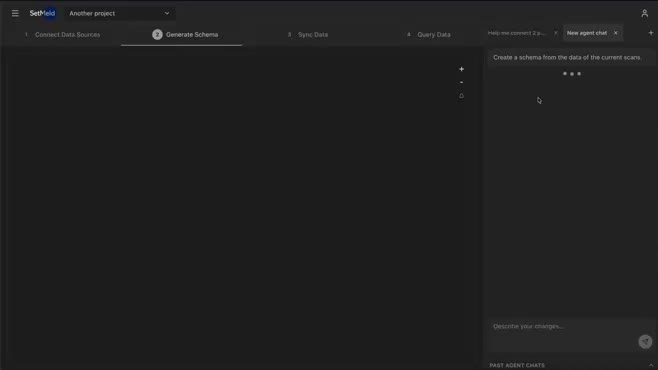
SetMeld Composer generating the pipeline configuration
The team has delivered data systems for
Every AI, analytics and compliance initiative depends on unified data.
Getting it today means months of bespoke pipelines, built by expensive system integrators or by forward-deployed engineers who walk out when the contract ends.
of the 957 applications the average organization runs are connected to each other
MuleSoft, 2026 Connectivity Benchmark Report, survey of 1,050 IT leaders
of AI projects will be abandoned through 2026 where the data behind them is not AI-ready
Gartner, February 2025
The five stages
Connect any structured source
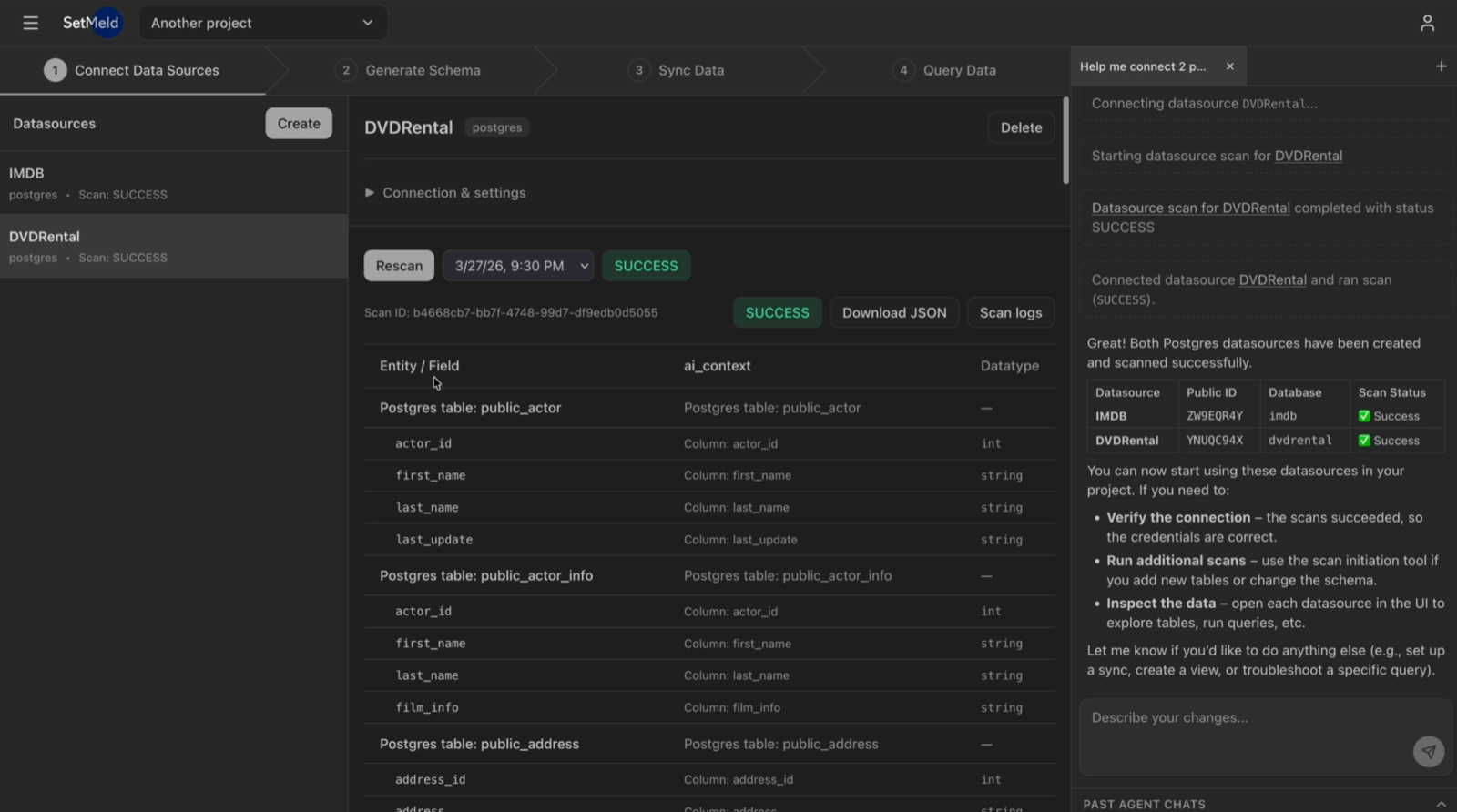
Databases, APIs and internal systems. Credentials go in through a guided flow, and SetMeld Composer scans each source to prove extraction works before anything is designed.
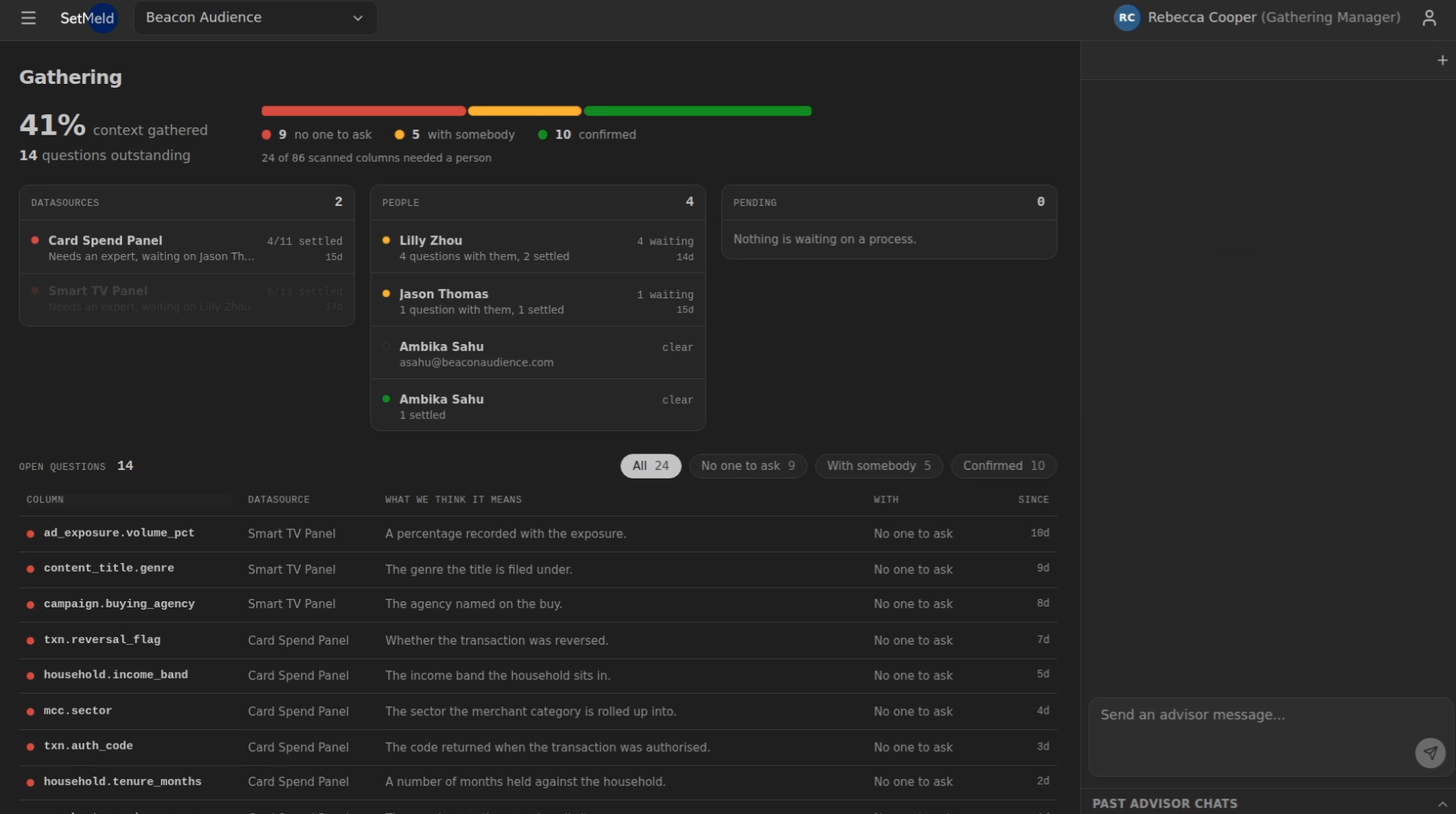
Gather the context that explains it
A column named CX138 means nothing on its own. The gathering agent flags every element the scan cannot settle alone, emails the one person likely to know, and records their answer against the column, tracking how much context you have until there is enough to build the graph.
Let AI design the integration
The AI pipeline determines the ontology, schema and entity resolution rules needed to unify your sources, then reports the data quality problems it found. Your team approves the design before it runs.
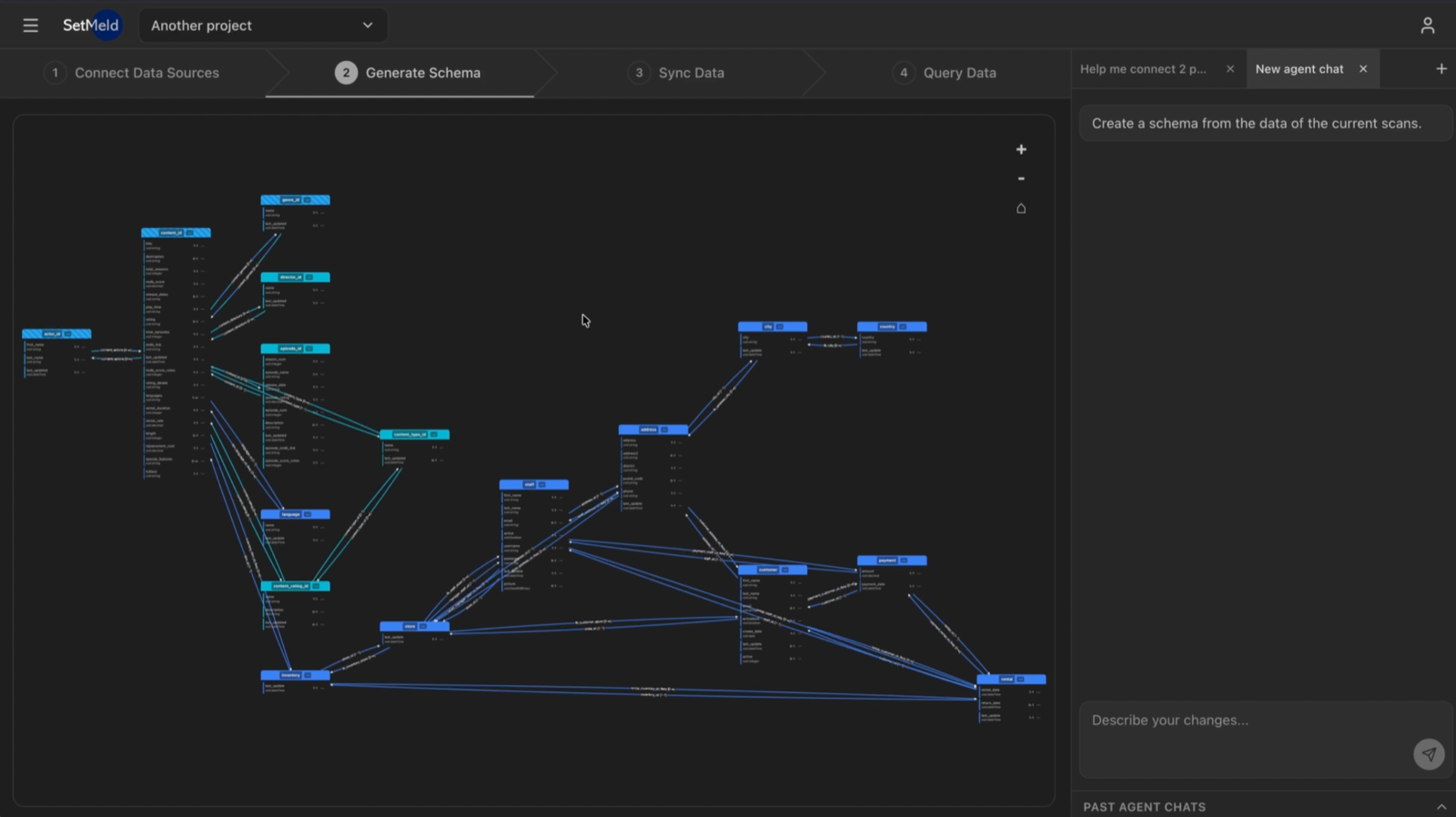
Sync into one governed model
Approved configurations go to SetMeld Pipeline, which extracts, transforms, resolves entities across systems and loads the knowledge graph. Once, or continuously, with every operation logged.
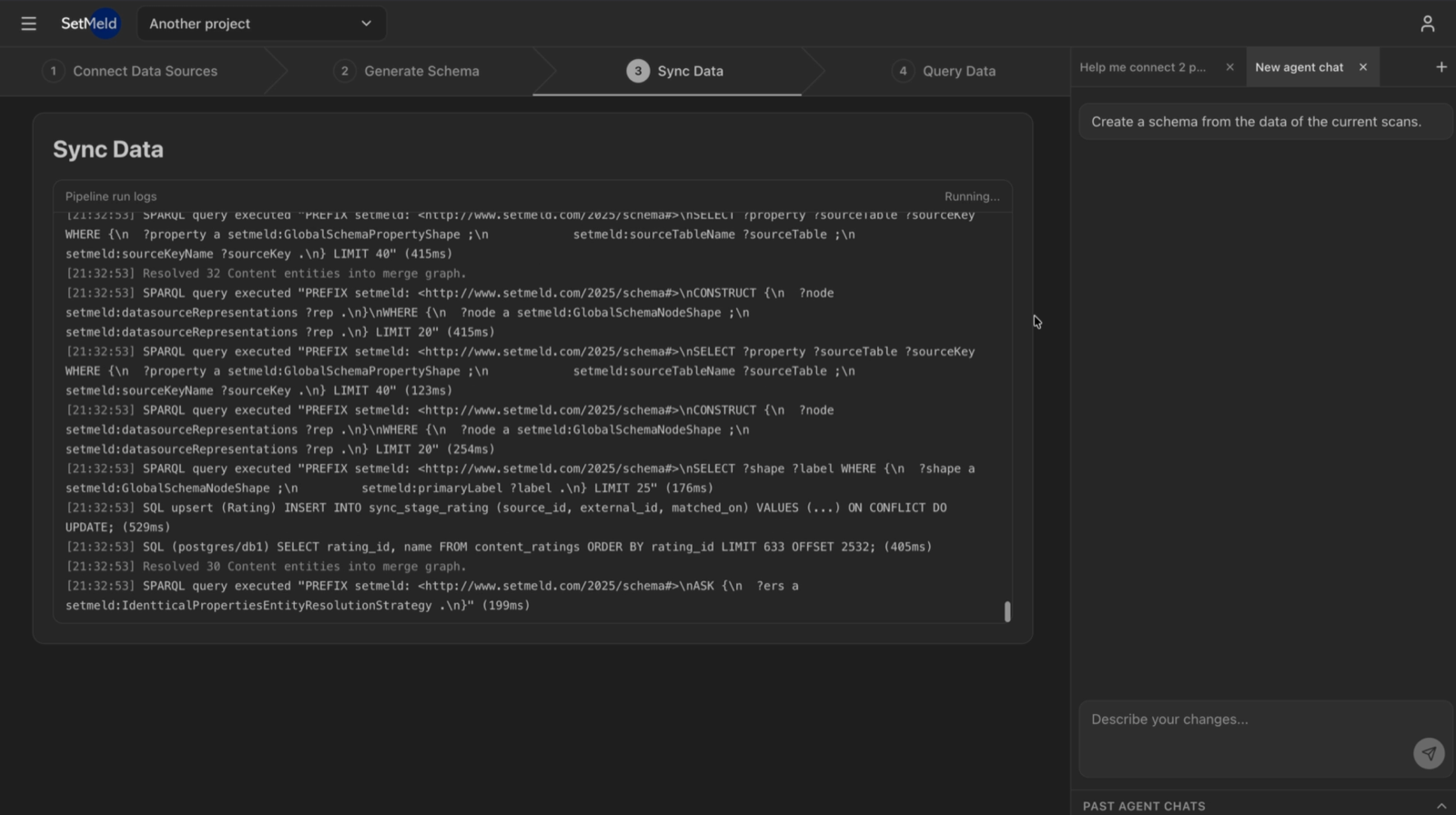
Query everything from one layer
BI tools, applications, analysts and AI agents all read the same trusted layer. Every answer carries datasource attribution back to the systems that produced it.
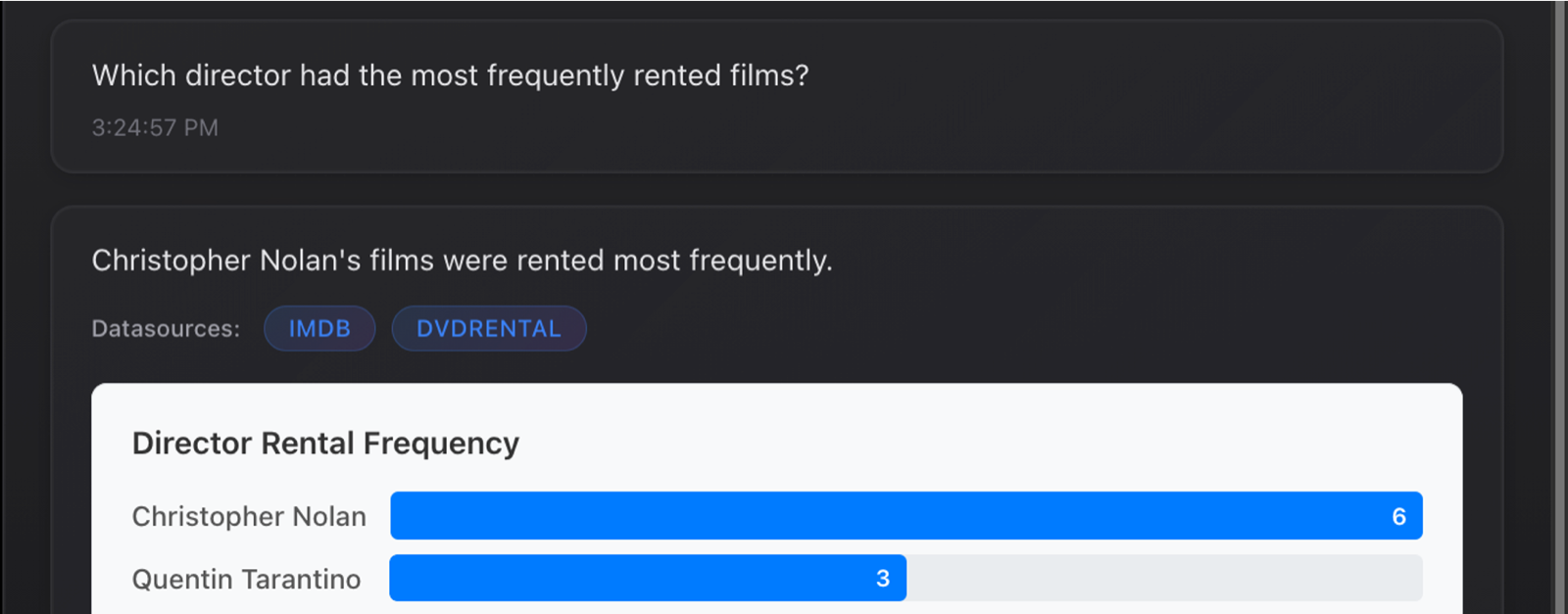
What you get
Delivered in weeks
The integration is generated, verified by our experts and approved by your team, so a unified model arrives in weeks rather than over the course of a program.
One subscription, unlimited integrations
Sources arriving through growth or acquisition become additional connections, at no additional project cost.
Runs where your data lives
On-prem, private cloud or SaaS. Your existing systems stay in place, with access control, audit trails and provenance on every transformation.
Where SetMeld sits against the alternatives
Each of these is the right answer to some problem. The question is what you give up: the labor, the semantics, or the ability to trace an answer back to a record.
| Approach | Unified model across sources | Entity resolution between systems | Stays current as sources change | Adding the next source |
|---|---|---|---|---|
| Manual reconciliation | Repeat the work by hand | |||
| Integration consulting | A new project | |||
| ETL and iPaaS tooling | A new pipeline to build and own | |||
| Search over documents | Indexed automatically | |||
| SetMeld | A new connection |
Approaches rather than named products, because capabilities differ considerably between vendors and between deployments of the same vendor.
Where SetMeld is used
Clinical & life sciences
Trial, registry and operational systems in one research-ready model.
ExploreFinancial services
One client, one exposure, one number, with lineage attached.
ExploreManufacturing & supply chain
ERP, MES, quality and supplier data joined across plants.
ExplorePublic sector
Cross-agency data sharing with sovereignty preserved end to end.
ExploreMergers & acquisitions
Combined visibility on day one, before systems consolidate.
ExploreAI agents & analytics
A governed substrate with provenance and permissions intact.
ExploreFrequently asked questions
Do we have to migrate our data?
Where does the data actually live?
Which LLM does it use?
How is this different from RAG or an AI search tool?
What happens when a source system changes?
Can we keep our existing data lake?
How long does the first integration take?
Deploy one unified knowledge graph of your data in days, not quarters.
Bring us two systems that should agree with each other and do not. We will show you what a unified model of them looks like.