Research data that answers questions across every study at once
Every study builds its own capture instrument, its own field names and its own coding conventions. The result is a department where each dataset is internally immaculate and collectively unusable, and where the reconciliation work falls to the researchers least able to spare the time.
Consistent within a study, inconsistent across them
Every study is its own schema
REDCap projects, EDC builds and registry extracts are designed per protocol. The same measurement appears under three field names with three coding schemes.
The data cannot leave
Patient data is governed by ethics approvals and residency rules that make shipping it to a third-party cloud a non-starter, regardless of the vendor’s certifications.
Reconciliation eats the research
Cohort discovery across studies becomes a manual exercise in spreadsheets, repeated every time a question changes and re-done whenever an instrument is amended.
Trial, registry and operational systems in one model
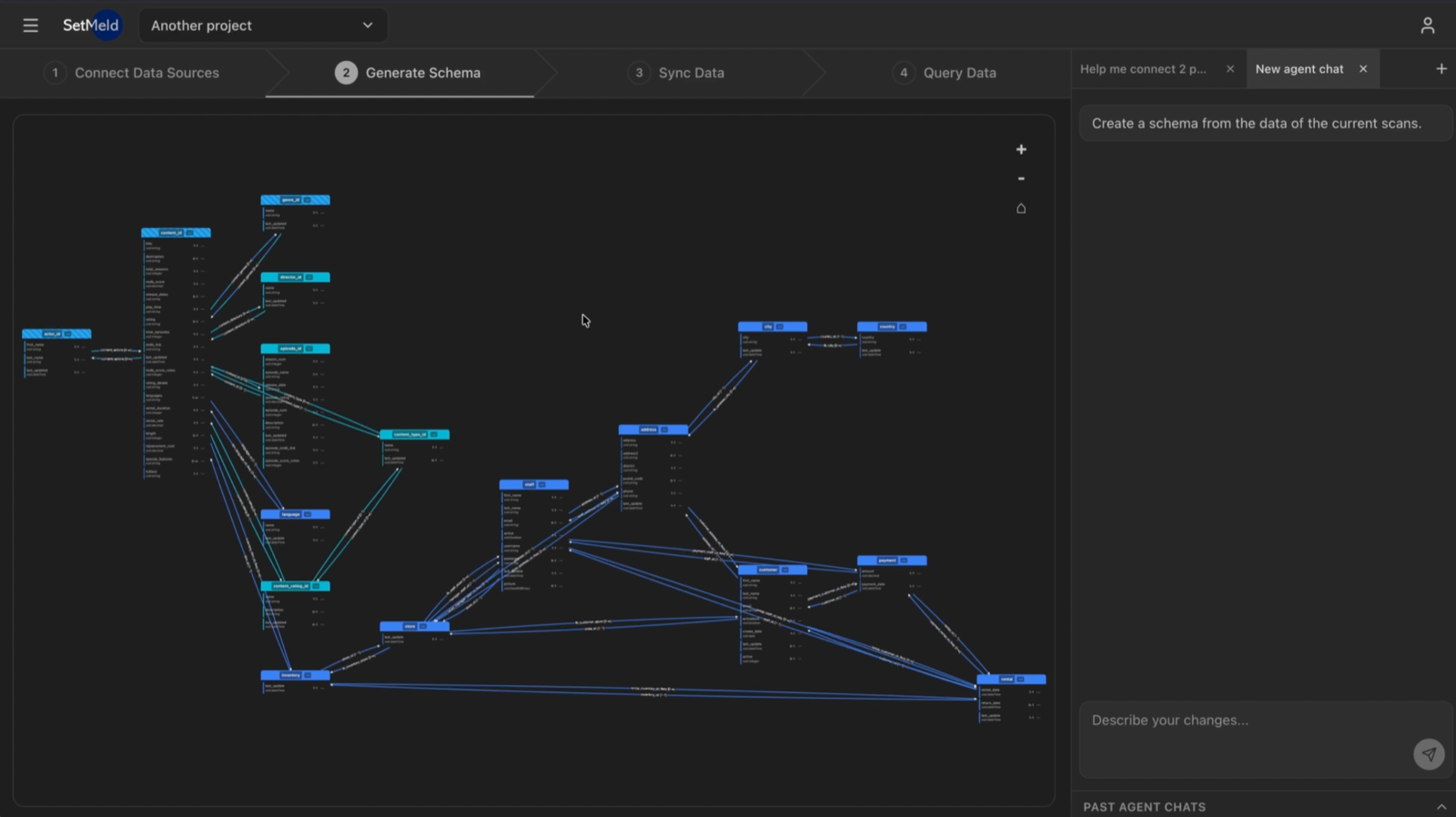
SetMeld Composer scans each source and infers what the fields actually mean, helped by any data dictionaries and protocol documentation you upload, then designs the mapping into a single governed model. Entity resolution decides when records in different systems refer to the same participant, site or intervention.
Representative systems. SetMeld connects to any structured dataset you have credentials for. No migration, no modernization prerequisite.
Answered in one query, with provenance
- How many participants across all our studies meet this inclusion criterion?
- Which sites recruited under target, and how does that vary by protocol amendment?
- Where do the same participants appear in more than one study or registry?
- What is the complete data-quality picture across every active instrument?
- Which datasets contain a given variable, however it happens to be named there?
Why the answer is trustworthy
Every result is computed over governed, unified records rather than retrieved from a pile of text. Each answer carries datasource attribution back to the systems that produced it, and agents querying the graph inherit the same access controls as the people who own the underlying data.
The integration is generated, verified by our experts and approved by your team.
Deploy on-prem, in private cloud, or as SaaS with the graph resident in your network.
New sources are additional connections at no additional project cost.
University of Oxford, Department of Paediatrics
SetMeld unifies clinical research data across differently structured REDCap systems, running entirely inside Oxford’s own infrastructure. No patient data leaves the university network. SetMeld Composer, SetMeld Pipeline, the knowledge graph and the reasoning model all run inside it.
Every component inside the university network
Differently structured REDCap instances reconciled into one model
Running in production today
What changes for a research department
Cohort discovery in minutes
Feasibility questions get answered while the conversation is still happening, rather than becoming a two-week data request.
Governance preserved
The graph runs inside your infrastructure, provenance is carried on every record, and access controls follow the data into every query.
New studies connect without a new project
A new instrument is a new connection. The unified model absorbs it instead of starting another reconciliation exercise.
Bring two studies that should be comparable
We will show you the unified model, running inside your own environment.