
Any structured dataset, connected where it already lives
Integration begins by connecting the source systems. There is no migration step, no staging rewrite and no requirement that a source be modernized first. If it holds structured data and you have credentials for it, it is a candidate.
Representative sources. Connection is credential-based through a guided flow. If you can query it, SetMeld can scan it.
Diagnosing a failed connection
Most integration projects lose their first week to firewalls and service accounts. When a connection fails, SetMeld Composer’s assistant diagnoses the problem and coaches the administrator through resolving it: a network restriction, a permissions gap, a misconfigured credential.
- Documentation is an input. Upload data dictionaries, schema notes and internal wikis alongside each source to improve mapping quality.
- Ambiguity gets a question. If a point of confusion remains after scanning, the model asks rather than guessing.
- Scan status is honest. A successful scan proves extraction will work; a failed one tells you precisely why.
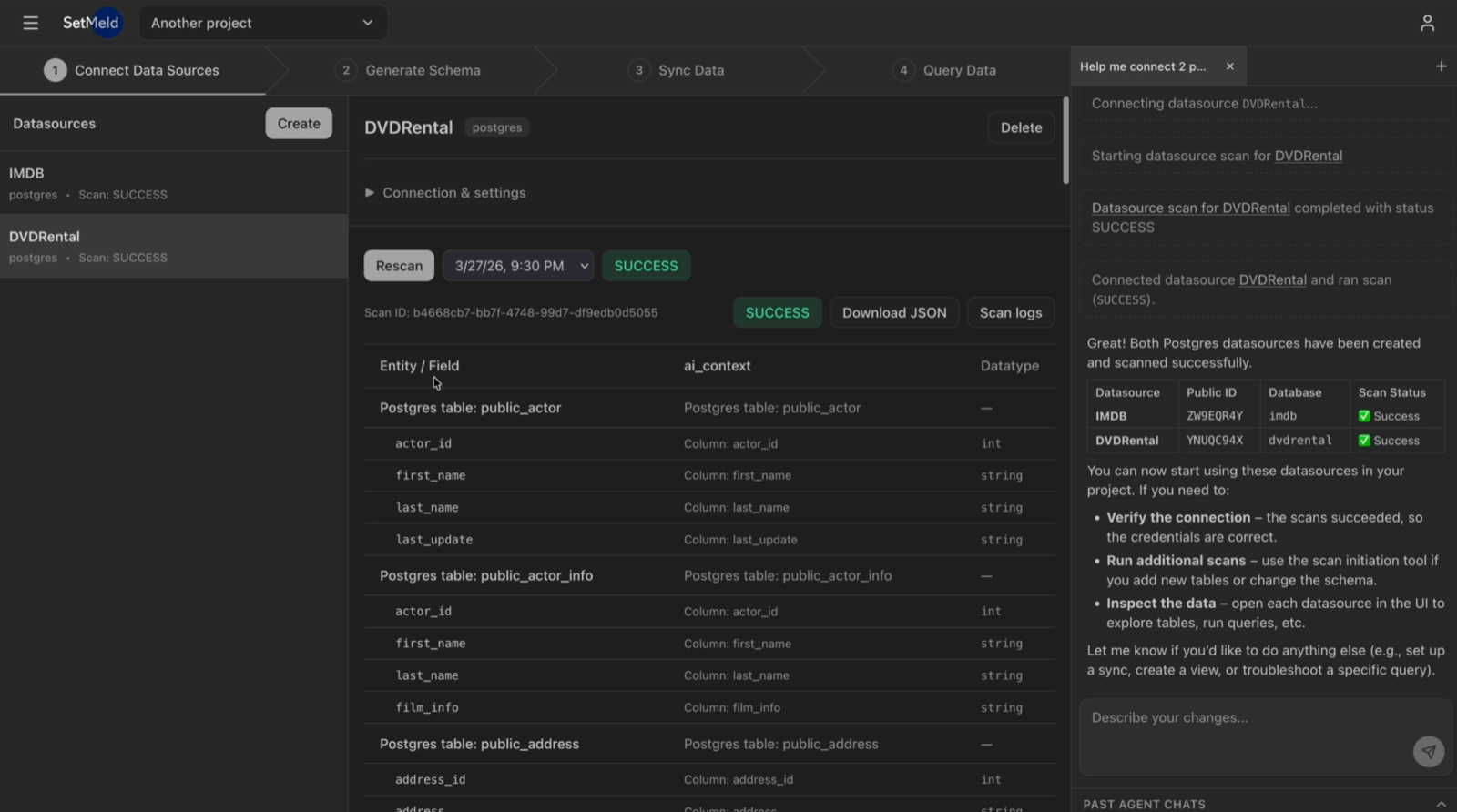
The AI context
SetMeld Composer scans each database and extracts a structured description of every entity, field and datatype, enriched with inferred meaning. This is what the design stage reasons over.
Structure
Tables, columns, datatypes, keys and the relationships already declared between them.
Meaning
Inferred semantics for fields whose names are abbreviations, legacy codes, or somebody’s initials from 2011.
Proof of access
The scan runs through the same paths the SetMeld Pipeline will use, so connectivity is verified before design begins.
Unsure whether a source qualifies?
Send us the shape of it. Structured data in an obscure system is the normal case.