
University of Oxford: clinical research data, unified inside the university’s own network
The Department of Paediatrics runs research across differently structured REDCap systems. SetMeld unifies them into one governed model, and every component, including the reasoning model, runs inside Oxford’s infrastructure.
In production today
Entirely inside Oxford’s infrastructure
Differently structured instances, one model
The situation
Clinical research generates data capture instruments per protocol. Each one is designed by the study team that needs it, with the field names, coding schemes and structures that suit that study. Individually they are fit for purpose. Collectively they make any question that spans studies, such as how many participants across the department meet a given criterion, where the same participants appear more than once, what the data-quality picture looks like across active instruments, into a manual reconciliation exercise.
The constraint that rules out most tooling is regulatory. Patient data is governed by ethics approvals and residency requirements. Sending it, or even schema samples of it, to a third-party cloud service is not a procurement conversation; it is a non-starter.
What SetMeld does
SetMeld is deployed in the fully self-hosted model. SetMeld Composer, SetMeld Pipeline, the knowledge graph and the reasoning model all run inside the university’s own network. SetMeld Composer scans the connected REDCap systems and extracts an AI context describing every entity, field and datatype; the AI pipeline designs the unifying ontology, the transformations and the entity resolution strategies; the department’s team reviews and approves the design before anything runs; SetMeld Pipeline executes it and keeps the graph current.
Because the reasoning model is supplied and hosted by the university, sensitive schema information and data samples are never transmitted outside the network.
Why the self-hosted model mattered
- No patient data, and no description of patient data, leaves the university’s infrastructure.
- The reasoning model is one the institution has already assessed and approved.
- Provenance is carried on every unified record, so any answer can be traced back to the instrument it came from.
- Access controls governing each source system continue to apply to queries against the graph.
What it changes
Questions that previously required a data request and a fortnight of reconciliation are answered against a single model, with attribution back to the source instruments. New studies become new connections rather than new integration projects, which matters most in an environment where the number of instruments only ever goes up.
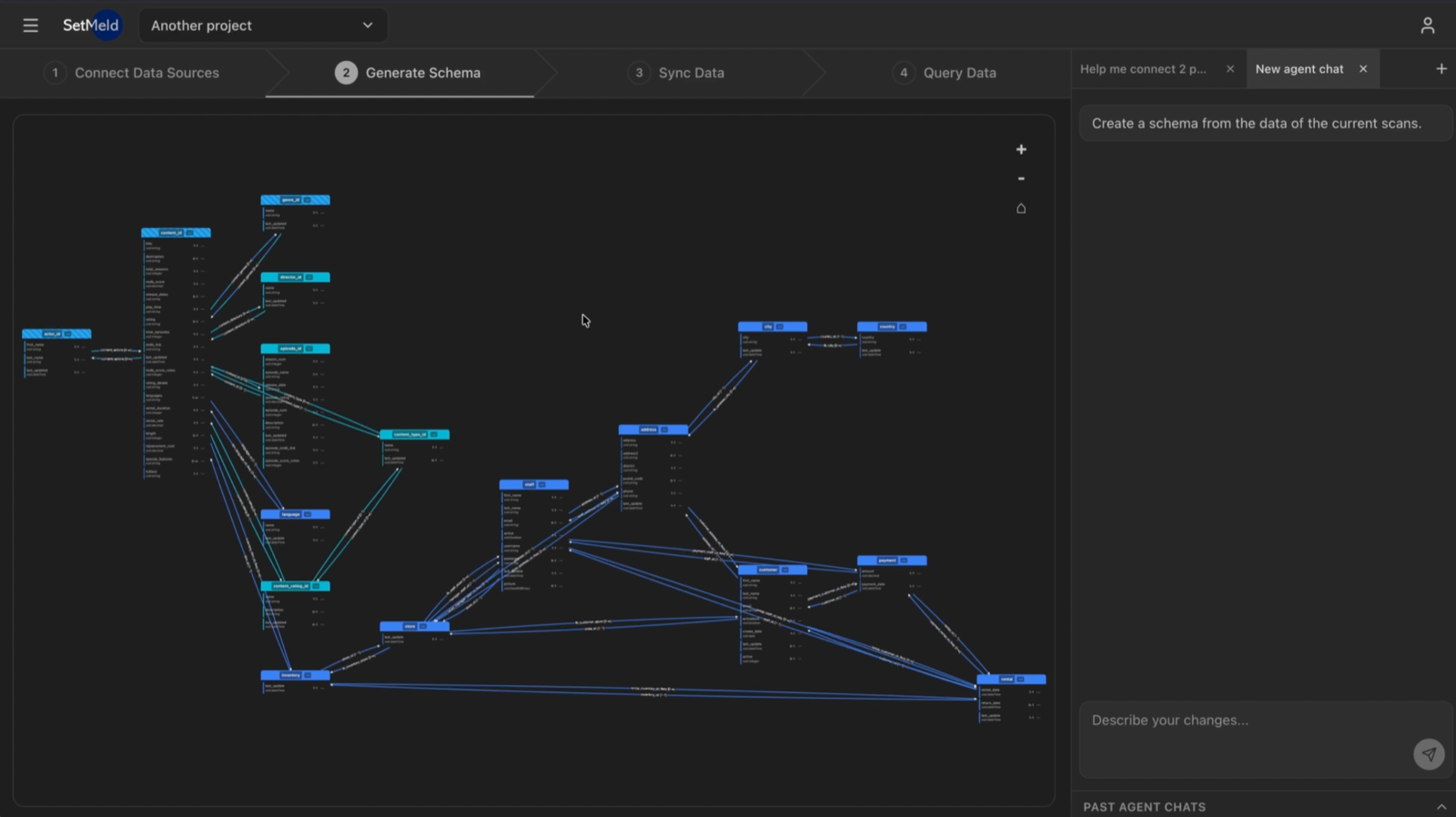
SetMeld Composer derives a unified schema across connected sources. Screenshot shows a demonstration project, not Oxford data.
Who this applies to
Research organizations
Universities, institutes and hospital trusts running many studies on many instruments.
Clinical & life sciencesRegulated public bodies
Departments and agencies where sovereignty and provenance are statutory requirements.
Public sectorOrganizations with a hard perimeter
Organizations for whom a managed AI service is excluded before the feature comparison begins.
Deployment modelsRun the same deployment inside your network
Self-hosted deployment, your choice of model, nothing transmitted outside your infrastructure.